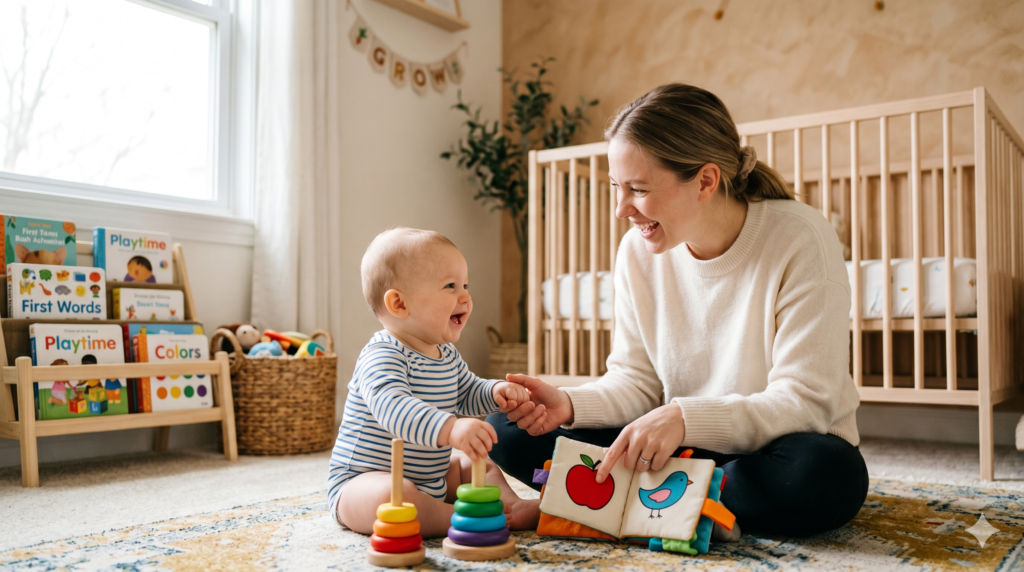
Your baby may not be talking yet, but that does not mean they are not communicating. From the first days of life, babies use sounds, facial expressions, eye contact, crying, reaching, and movement to connect with the people around them.
The good news for parents is simple: you do not need flashcards, expensive toys, or special programs to support your baby’s brain development. Everyday interaction is one of the most powerful tools you have.
Here are five simple ways to help your baby learn, communicate, and connect.
1. Respond to Your Baby’s Sounds and Expressions
When your baby coos, smiles, looks at you, or makes a sound, respond. Smile back. Talk back. Copy their sounds. Make eye contact.
This back-and-forth interaction is often called “serve and return.” Harvard’s Center on the Developing Child describes serve and return as responsive exchanges between a child and caring adult that help shape brain architecture and support early language and social skills. (Developing Child Harvard)
You can say things like:
“That was a big smile!”
“I hear you talking!”
“You see the dog? Yes, that’s a dog!”
These tiny conversations help your baby learn that communication matters.
2. Notice What Your Baby Notices
As babies grow, they begin to share attention with you. They may look at a toy, look back at you, reach for something, or eventually point. This is an important part of early communication because your baby is learning to share their world with you.
When your baby looks at something, talk about it.
“You see the ball.”
“That puppy is barking.”
“Look at the light!”
The CDC lists early communication and social behaviors at 9 months, including making sounds like “mamamama” and “bababababa,” lifting arms to be picked up, smiling during peekaboo, and reacting to familiar people. (CDC)
3. Try Simple Baby Signs
Some families teach simple signs like “more,” “milk,” “eat,” or “all done.” This can help because babies often understand more than they can say.
The CDC even suggests simple baby sign language as one way to help a baby tell you what they want before they can use words. (CDC)
The key is to say the word while using the sign. For example, say “more” while making the sign for more. Signs should support speech, not replace it.
4. Talk Through Everyday Routines
You do not need formal lessons to teach your baby language. Just talk during normal daily activities.
During diaper changes, say:
“Let’s get a clean diaper.”
“Now we are putting on your socks.”
At mealtime, say:
“This is banana.”
“You like the spoon.”
During walks, say:
“I see a tree.”
“That car is loud.”
The CDC encourages parents to repeat a baby’s sounds, say simple words, read by talking about pictures, describe what the baby is looking at, and use facial expressions and voice to show feelings. (CDC)
5. Choose People Over Screens
Screens can hold a baby’s attention, but they do not replace face-to-face interaction. Babies learn best from real people, real voices, real facial expressions, and real back-and-forth play.
The American Academy of Pediatrics says that from birth to 18 months, babies are building secure relationships, early language, movement, and emotional skills—and media should not crowd out those important tasks. (HealthyChildren.org)
Video chats with family can be helpful because they involve real interaction, but infants do not learn much from passive screen time such as cartoons or nursery rhyme videos. The AAP also warns against prolonged TV or YouTube viewing for infants. (HealthyChildren.org)
The Big Message for Parents
You do not have to be perfect. You do not need to turn your home into a classroom. Your baby’s brain grows through simple, loving, everyday moments.
Talk to your baby. Smile back. Sing. Read. Play peekaboo. Follow what they notice. Respond when they make sounds.
Those small moments are not small to your baby. They are how your baby learns language, connection, trust, and curiosity.
Article Source:
This article is based on early childhood development concepts discussed by pediatrician and author Dr. Laura Jana, along with guidance from trusted pediatric and child development sources. https://www.youtube.com/watch?v=0YYHbu26nh0