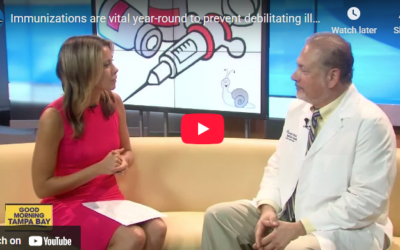
Tampa Bay Health podcast, and we’re here with Dr. John Aime here in Plant City, Florida, in his beautiful practice. Dr. Aime, thank you for being with us.
Can you tell us a little bit about yourself?
Well, if you want to go way back, I was born in Brooklyn, New York, born and raised. I went to New York University for undergrad, then went to St. George’s University School of Medicine. I did my residency back in Manhattan at Beth Israel Hospital downtown. When I finished residency, I came straight to Plant City and opened up my own private practice in general pediatrics, and I’ve been here for 35 years now.
Okay, what led you to become a pediatrician?
Well, I just always enjoyed working with kids. I always liked medicine, but working with kids was always fun and rewarding. So, I thought about a few other fields but always came back to pediatrics and then pursued pediatrics, and I’m glad I did. I enjoy it.
So, you’ve been here for 35 years. What do you do for fun in your spare time, if you have any spare time?
Well, we do have some spare time, and it gets less and less it seems. I do have a couple of hobbies. I do some sleight of hand magic and illusions, and we have a few clubs around town that I go to. We have some kindred souls that are also magicians, so I like to study the history of that and presentations and illusions. I also do a little bit of gardening, get out there and grow some stuff, and go to the gym now and then when I can, try to keep fit, walk around a little bit. And that’s about it, really. It’s about all the spare time I have.
Okay, well, what we’ve done is we’ve gone in and researched probably a hundred questions, but we’re gonna pick a few things that new mothers are asking pediatricians. Okay, first one:
What are the best first foods for a baby, and when should I start introducing solid foods to my baby?
Okay, good question. As pediatricians, we always encourage breastfeeding first if you can. Breastfeeding is the best way to go for a baby. If not, there are some formulas that we may recommend. But breastfeeding provides not only great adequate nutrition but also provides protection to the baby via antibodies that the mom has, which she’ll pass along in the breast milk. And also, it creates a psychological bond that moms develop with the baby while they breastfeed, which is very important for the baby’s mental well-being. We will then start introducing solids usually at around six months or so. Usually, we’ll start with cereal, oat-based cereal, maybe the first one to start with. And we’ll do that with a spoon. We try not to put that in the bottle. If we’re doing good with that, then maybe in a few weeks, we may try a single pureed vegetable three or four days after that. If we’re doing well, we may try a new one three or four days after that. We space them out so that if there’s a problem with one, we know which one it is, rather than doing multiple veggies at a time. And then eventually, after three or four veggies, you may want to try a fruit and just kind of proceed on with that.
So, I’m curious, how common would it be for babies to have allergies?
Yeah, we do see newborns who develop allergies in the first several months, sometimes to food, more so with formula than we’ll see with breast milk. Again, that’s another reason we encourage breast milk. Or to some of the solid foods, generally speaking, we see that allergies may run in the family, and that’s a big tip-off. So, family members may have allergies, specifically to foods, or they may actually have related things like skin problems, like atopic dermatitis, eczema, psoriasis. And you may actually see in the baby early on that they have bad cradle cap or they develop eczema. That may also be occluded. They may develop food allergies also. In the family, you might find that a lot of people have environmental allergies, a little reactive airway asthma, things like that, which are kind of linked with food allergies and other allergies.
When should I start brushing my baby’s teeth?
Okay, that’s a good question. Generally speaking, the babies will erupt teeth starting at about four months, but there’s a lot of variation in that. I’ve seen some babies born with a tooth, and then again, some babies who don’t have any teeth until 11 or 12 months old. But again, the average is about four months. So, what we should do at that point is after feedings, at least wipe it with a towel, whether it’s a paper towel or a cloth towel, mainly to get the food substance off the teeth. The carbohydrate that’s in the food will turn into sugar with the saliva in the baby’s mouth, and that can cause some problems with tooth decay, can cause some pretty nasty problems, things we call bottle mouth and such. As you get more teeth in, then you may try with a toothbrush. They are toothbrushes that are made for kids, and they also have little pieces that fit on the fingers that you can use to brush. That’s important, especially when you give a feeding at night and putting the baby to sleep, or if you feed the baby in the middle of the night, it’s very important to wipe the teeth because you can get the tooth decay overnight. We also recommend seeing a dentist probably around two years of age for a regular visit unless there’s a particular problem that you can see with the teeth, then you may see the dentist earlier.
How can I help my baby develop and reach milestones on time?
Another good question. Milestones are very important. When you visit the pediatrician, they will often ask you questions about what the baby’s doing at that age. So, is the baby rolling over? Is the baby sitting up? Is the baby saying any words? Is the baby crawling? Walking? Those are important milestones, and there are some variations in those. But there are some general rules that we follow. If the baby is delayed, then there are certain things that we may have to do. If there’s a speech delay, we may have to get a speech evaluation, get the hearing checked again. The hearing is always checked in the nurseries now before the baby leaves the hospital, but we may have to check it again if it’s a problem later on. A speech problem. It’s always important when the doctor asks these questions or the nurse who’s working the patient up that you’re honest with those answers because it’s very important that we catch these things early so we can intervene if there is a problem. Now, stimulating the baby is important, so a baby who’s not stimulated will probably develop some delays in motor function. So, parents, caretakers, siblings, especially grandparents, they’re usually good at this, playing with the baby, stimulating the baby. That’s extremely important for the baby’s development. So, we encourage a lot of interaction with the baby. Okay, it makes total sense. Socialization with the family. Okay, all right, next question. What vaccines does my child need, and when should they get them? Okay, good question. We do quite a few vaccines in the first two years of life. Basically, the idea of a vaccine is that you’re introducing usually protein particles that are similar to bacteria or viruses, and that helps the body’s own immune system build up antibodies which will fight them if they ever encounter the actual bacteria or virus. So, there is a kind of set schedule that we follow. The best thing to do is to look at a website. The American Academy of Pediatrics has an excellent website. It’s www.aap.org/immunizations, and you’ll see a whole table about the shots that we give. Most of these vaccines that we give are for very serious infections. A lot of them are life-threatening. There were a few that came out after I was in residency, and we don’t see those diseases anymore in kids. But as a resident, I saw quite a few serious diseases that we now can help protect the child against. So, it’s very important to keep up with the immunization schedule. If there are any concerns about immunizations, you should feel free to talk to your pediatrician or family doctor about those concerns.
How can I help my child maintain a healthy weight?
So, this has become more and more a big problem. The number of obese children is actually rising at frightening rates. Probably a lot of it has to do with a more sedentary lifestyle. Kids are attracted to computers and cell phones and tablets. A lot of kids just don’t get out and do the exercise. Another problem might be where both parents are working, and there’s no time to come home and cook a good meal, so they end up eating fast food, which is not the best for you. On occasion, it’s okay, not something you want to be eating every day. So, it’s important that the diet is good. Fresh foods are important. It’s important that you get activity. You have to get outside, spend some time outside. You can’t be on the computer, you know, five hours a day and getting no exercise. Getting outside, sports are a great way to do it. A lot of kids are involved in sports: baseball, soccer, gymnastics, cheerleading. And that’s all good exercise. A sound mind and a sound body go together, and the ancient Greeks knew that thousands of years ago.
When should I bring my child in for a checkup?
Okay, again, that also depends on the age. Generally speaking, once the child is in kindergarten, around five years old, it’s good to have a checkup on a yearly basis, similar to what we should be doing as adults as well. Early on, it’s also motivated by the vaccine schedule. So, typically, when a baby’s born, we’ll see them a few days after they’re released from the hospital, and then about two weeks and three weeks. At about two months, we’ll start with immunizations. Now, they may have gotten one in the hospital already, but when we get them at two months, we start the immunizations. And initially, it’s two months, four months, six months. We’ll usually check them again at nine months. Those are important, not only for the vaccines but also to check the milestones, as we talked about, see how the child is developing and look for any problems that might exist. So, shots at a year, 15 months, and then it kind of slows down to four years old, five years old. Flu shots may be given every year. They are recommended for children over six months. After that, it’s yearly checkups, and in sixth grade, we usually give a set of boosters as well when the child is usually about 11 years old. So, once they get a little older, just yearly checkups, kind of the way we’re supposed to be doing it with our doctors.
You’ve been in business here for 35 years. What trends have you seen over these years?
Well, as far as diseases, like I said, fortunately, with some of the immunizations we have, we see less of the serious things. We reduce the occurrences. Occasionally, there’s a little blip where things return, like the measles. We may see whooping cough, things that we do immunize and have been immunized for a while. And often, that’s in communities where people are not getting shots, not getting immunizations. That can be a concern. As I mentioned earlier, too, the obesity issue is a big problem, and that seems to be getting worse almost at an exponential rate. So, those are some of the trends we’re seeing. Again, kids who are addicted to their computers, their laptops, this is also a worrisome trend that we see. So, things that we’re keeping an eye on and trying to encourage parents to work with.
Makes sense. Striking a balance between what they love on the technology side and adding sports and activities is probably the hardest thing the parent has to do right now, right?
Right. And a lot of the younger parents are also sort of hooked on Facebook, Twitter, and TikTok, and what have you. And it becomes almost addictive for a child and a parent as well. There are certain techniques that they use, especially with things like TikTok, where they hook you into it, and it’s hard to put the phone down. It becomes like an addiction, and it’s a time thief as well as losing time with your family, losing time with your children. So, that’s another trend I see, as we’re in a generation of younger parents who also grew up with this technology. And sometimes, I worry about that interaction with the children.
Well, thanks, Dr. John. We appreciate your time and talking with us, and I’m sure people are going to really enjoy listening to this podcast. Thank you very much.